

Q: I have had a persistent headache in my right eye and sinuses, yet my sinuses are clear. Can you help?
A: If you’re struggling with an ongoing headache behind your eye or pressure in your sinus region—yet there’s no congestion, drainage, or obvious sinus infection—you’re not imagining things. And yes, help is available. This is a common complaint I hear in clinic, and the true cause is often missed by conventional diagnostics.
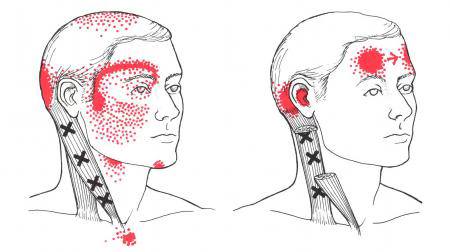
Many clients are surprised to discover that their pain isn’t stemming from sinus issues at all—but from muscular referral patterns, specifically from the sternocleidomastoid (SCM) muscle in the neck.
What Are Trigger Point Referral Patterns?
In the 1940s, Dr. Janet Travell mapped what are now known as trigger point referral patterns—predictable pain patterns that emerge when a muscle becomes dysfunctional or irritated. These maps remain valid for approximately 90% of the population. Among those, 90% feel pain, while about 10% experience other sensations such as pressure, tingling, numbness, or altered sensitivity.
The SCM muscle is a common offender in these type of headache cases. It’s a large, rope-like muscle that runs from behind your ear to your collarbone and is responsible for forward bending and rotation of the head. Daily habits such as prolonged computer use, device scrolling, driving, crafting, and even poor sleeping posture can all aggravate this muscle. Whiplash injuries, slips, and falls can further compound the issue.
Symptoms of SCM Referral Headache
When the SCM muscle is overloaded or restricted, it can refer pain and pressure to:
-
The area behind or around the eye
-
Forehead and cheekbones (often mimicking sinus pain)
-
The base of the skull
-
Inside the ear
-
The top of the head
A key indicator that your sinus-like symptoms are actually muscular is the sensation of sinus pressure without any discharge—nothing to blow into a tissue, just a lingering ache or fullness. SCM tension can also be associated with tinnitus (ringing in the ears), dizziness, or visual fatigue.
Myofascial Release for Headaches and Eye Pain
Although I began my massage therapy career over 24 years ago using traditional trigger point therapy, I soon shifted my clinical approach to focus on myofascial release techniques—a method I had originally studied in college but initially set aside because it wasn’t yet widely accepted in the mainstream. Embracing myofascial release proved to be a pivotal decision, laying the foundation for more effective and longer-lasting pain relief for my clients.
While trigger point therapy may offer temporary muscle relaxation, it often fails to resolve the root cause of dysfunction. In contrast, myofascial release therapy targets the entire fascial system, improving mobility, circulation, and neuromuscular coordination. This comprehensive approach also helps correct underlying postural imbalances, supporting lasting recovery.
Treating More Than Just the Neck
Long-term improvement also depends on restoring muscular balance and posture. In most cases, that means addressing not just the SCM, but the entire upper body kinetic chain:
Stretching to Improve Posture and Mobility: Key Muscle Release Techniques
Sternocleidomastoid (SCM) Stretch
Sit comfortably and hold a towel behind your neck for gentle support. Imagine your head as the needle of a compass and guide your gaze into the W, NW, N, NE, and E directions, pausing gently in each position. This dynamic stretch targets the SCM to relieve headaches, eye strain, and forward head posture.
Pectoralis Major & Minor Stretch
Stand in the corner of a room with your arms raised and elbows bent. Place your forearms against each wall and lean your body into the corner to feel a chest opening.
-
Begin with your shoulders at 70° abduction
-
Repeat at 90°
-
Then again at 135°
This layered approach addresses both superficial and deep chest tightness, helping to correct rounded shoulders and improve upper body posture.
Serratus Anterior “Grasshopper” Stretch
Stand sideways next to a doorway. Bend your elbow and tuck your arm close to your side, with your palm facing forward in front of your shoulder. Place your palm on the door frame, then step forward into a lunge. As you move, your arm should rotate back slightly like a “grasshopper leg,” gently stretching the serratus anterior and opening the front of the rib cage for better breathing mechanics and scapular mobility.
Subscapularis / Triceps Wall Stretch
Place your elbow against a wall with your hand hanging loosely behind your head and neck. Lean your body forward into the wall, creating a deep stretch along the back of your arm. This position targets both the subscapularis (a key internal rotator of the shoulder) and the triceps, helping to restore shoulder range of motion and reduce impingement caused by postural tension or repetitive strain.
Targeted Strengthening Exercises to Improve Posture and Stability
-
Rhomboids:
Strengthen these key postural muscles with standing rows using cables or resistance bands. They help retract the shoulder blades and stabilize the upper back. -
Infraspinatus:
Activate this external rotator of the shoulder by performing resisted external rotation exercises with cables or bands. This muscle is essential for shoulder stability and injury prevention. -
Middle Trapezius:
Build strength and endurance in the mid-back with prone reverse flyes. This helps counteract forward shoulder posture and improves scapular control. -
Spinal Erectors:
Support the spine and enhance core strength with “Superman” exercises performed face down on a yoga mat. This movement targets the erector spinae group for improved postural endurance.
Because poor thoracic posture almost always accompanies neck dysfunction, we must treat the thorax and neck together. It’s nearly impossible to sit upright and maintain good t-spine alignment while letting your neck crane forward.
Practical Lifestyle Fixes
Ergonomics also matter. Even the best-designed workstation won’t help if your body isn’t prepared to maintain good posture. With focused manual therapy and strategic home care—including strengthening and postural re-education—you can restore balance, reduce pain, and avoid recurrence.
You don’t have to live with daily discomfort or chase ineffective solutions.
Contact me today to book a clinical assessment and explore how targeted treatment can resolve the root cause of your head and sinus pain—for good.